
How to Choose the Perfect Wood Slab for Your Project: The Complete Buyer’s Guide
Choosing the right wood slab is one of the most important decisions you will make when building a live-edge table, desk, countertop, bench, shelf, bar top, mantel, or other solid wood project.
Every slab is different. Even two slabs cut from the same tree can have completely different grain patterns, colors, knots, edges, cracks, and natural character.
The right slab should not only look beautiful. It also needs to be properly dried, appropriately sized, structurally suitable, and compatible with the project you have planned.
This complete guide explains how to choose a wood slab based on species, dimensions, thickness, moisture content, grain, natural features, structural condition, and intended use.
Whether you are an experienced woodworker or planning your first DIY live-edge project, understanding these factors before buying a slab can save time, reduce waste, and help you create a finished piece that will last for generations.
Table of Contents
Start With the Finished Project
Before choosing a wood slab, decide what you want to build.
This may sound obvious, but it is easy to fall in love with a beautiful slab before considering whether its dimensions, thickness, species, and natural features are appropriate for the project.
Start by defining the finished dimensions of your project.
Consider:
- Finished length
- Finished width
- Desired thickness
- Indoor or outdoor use
- Expected weight and daily use
- Type of base or support structure
- Desired edge style
- Natural or refined appearance
- Whether epoxy will be used
- How the finished piece will be transported and installed
A dining table, for example, has different requirements from a floating shelf. A countertop needs different preparation than a decorative bench. An outdoor project requires additional consideration of wood species, construction methods, and finish.
Starting with the finished project helps narrow your slab choices before you begin shopping.
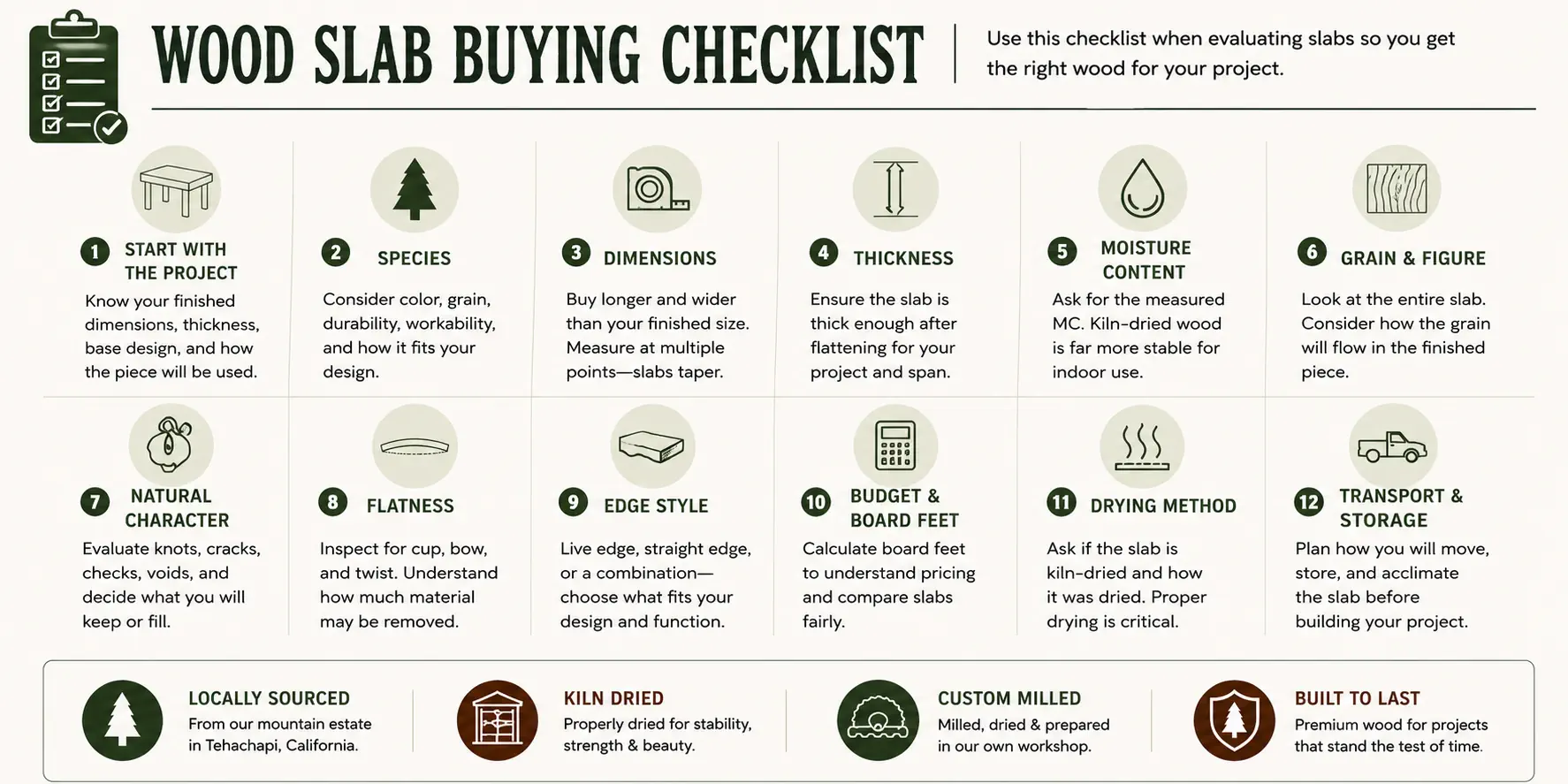
Choose the Right Wood Species
Different wood species have different characteristics. Color, grain, hardness, weight, stability, workability, and price can all affect the finished project.
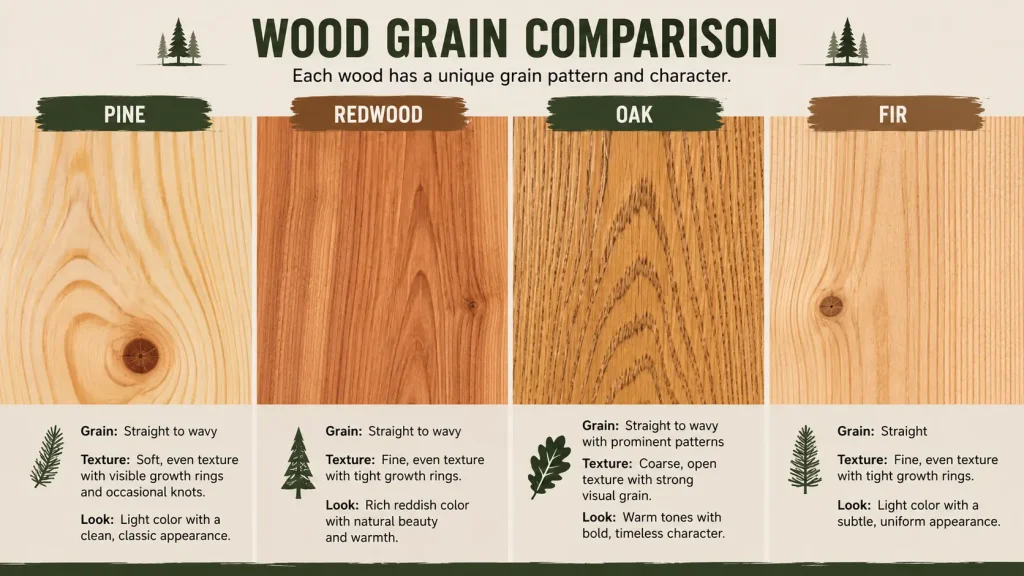
At Mountain Dog Millworks, our primary locally sourced species include Pine, Redwood, Douglas Fir, and Oak. Each offers distinct advantages.
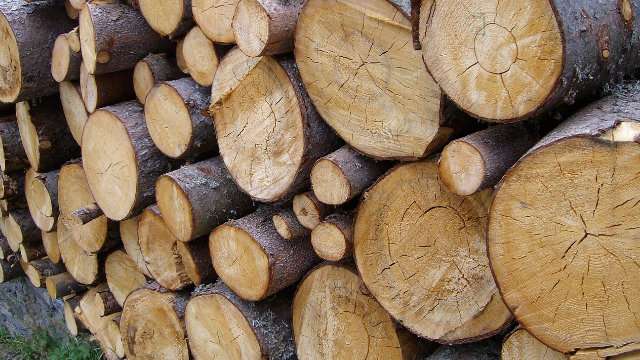
Pine
Pine is versatile, affordable, and relatively easy to work with.
Its light natural color, prominent grain patterns, and knots make it a good choice for rustic and contemporary projects. Pine accepts many stains and finishes, allowing it to be adapted to a wide range of interior styles.
Pine works well for:
- Tables
- Desks
- Benches
- Shelving
- Mantels
- Counters
- Decorative furniture
- Epoxy projects
Because Pine is softer than Oak, care should be taken when selecting it for surfaces that will receive heavy impact or abrasion.
Redwood
Redwood is valued for its rich color, dramatic grain, and natural beauty.
Colors can range from warm reddish brown to deeper red and chocolate tones. Redwood slabs can create striking tables, counters, bar tops, and statement furniture.
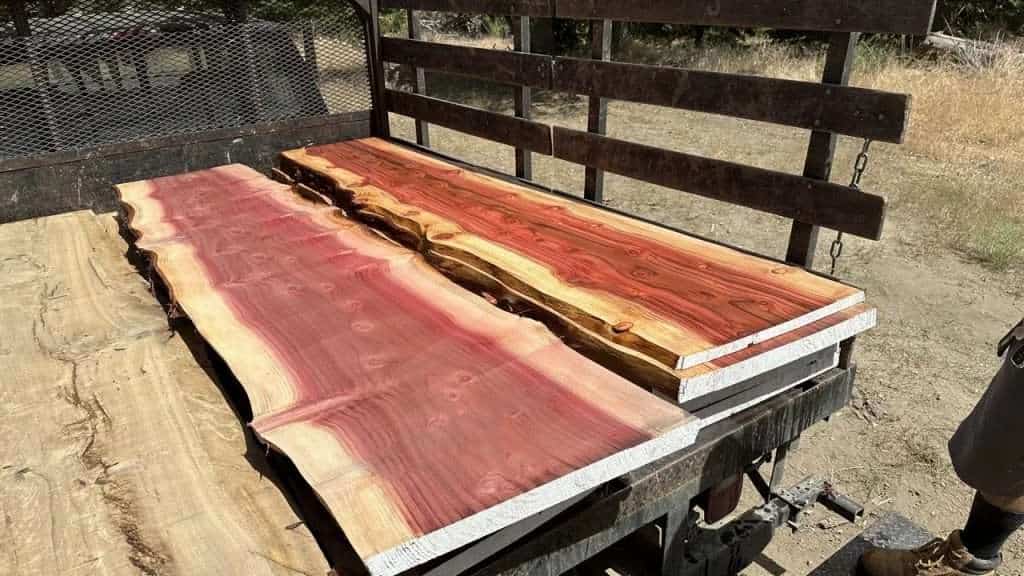
Redwood works well for:
- Dining tables
- Coffee tables
- Desks
- Bar tops
- Counters
- Benches
- Decorative statement pieces
Redwood is softer than Oak but can be an excellent choice when appearance and distinctive natural character are priorities.
Douglas Fir
Douglas Fir offers strong grain patterns and a warm, natural appearance. It can work particularly well in rustic, mountain, farmhouse, craftsman, and modern interiors.
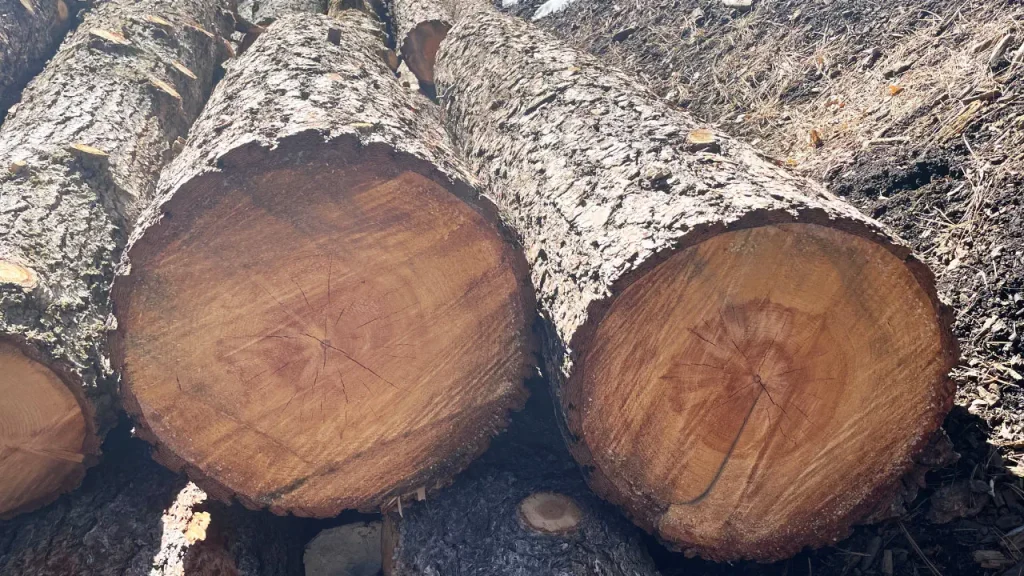
Douglas Fir is a practical choice for:
- Tables
- Desks
- Benches
- Shelving
- Mantels
- Counters
- Structural-inspired furniture
Its pronounced grain can become a major visual feature of the finished piece.
Oak
Oak is hard, durable, heavy, and well suited for furniture that will receive regular use.
Its distinctive grain and strength make it a popular choice for heirloom-quality furniture and heavily used surfaces.
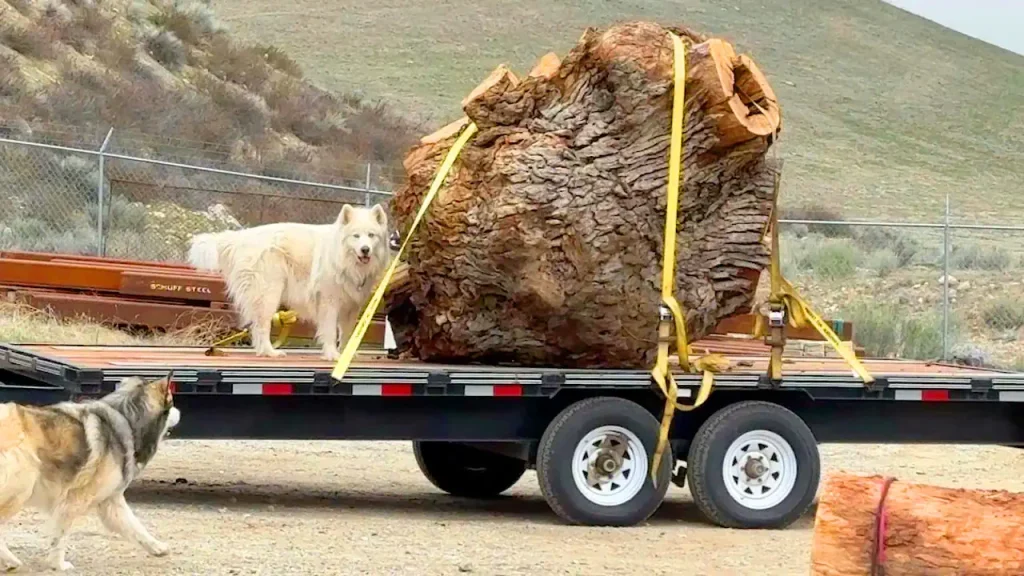
Oak is an excellent choice for:
- Dining tables
- Desks
- Countertops
- Benches
- Coffee tables
- Conference tables
- High-use furniture
Oak can require more effort to mill and finish than softer woods, but the result is an exceptionally durable finished piece.
Determine the Correct Slab Dimensions
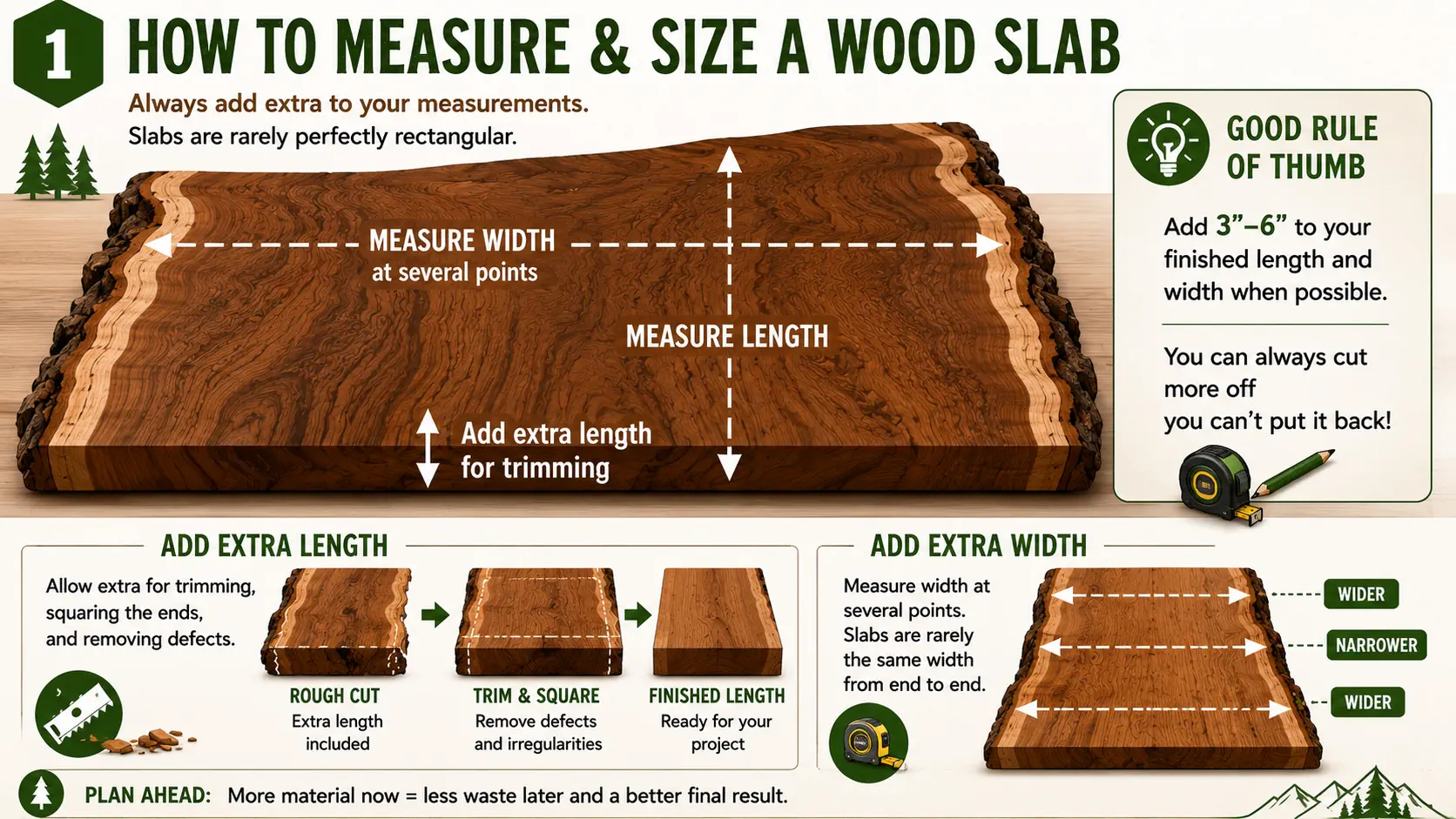
One of the most common mistakes when buying a slab is choosing one that is too close to the desired finished dimensions.
A rough wood slab usually requires some combination of flattening, trimming, jointing, sanding, and edge cleanup.
All of these processes can reduce the final dimensions.
If your finished table needs to be 72 inches long, buying a slab that is exactly 72 inches long leaves no room for trimming damaged ends or making final cuts.
Whenever possible, allow extra material.
For many projects, adding several inches of extra length provides useful flexibility. Width requirements depend on the slab shape and whether the natural live edges will remain.
Remember that live-edge slabs are rarely perfectly rectangular. Always measure the slab at several points along its length.
A slab described as 30 inches wide may be 34 inches wide at one end, 29 inches in the middle, and 32 inches at the other end.
The narrowest usable point may determine whether the slab is suitable for your project.
Choose the Right Slab Thickness
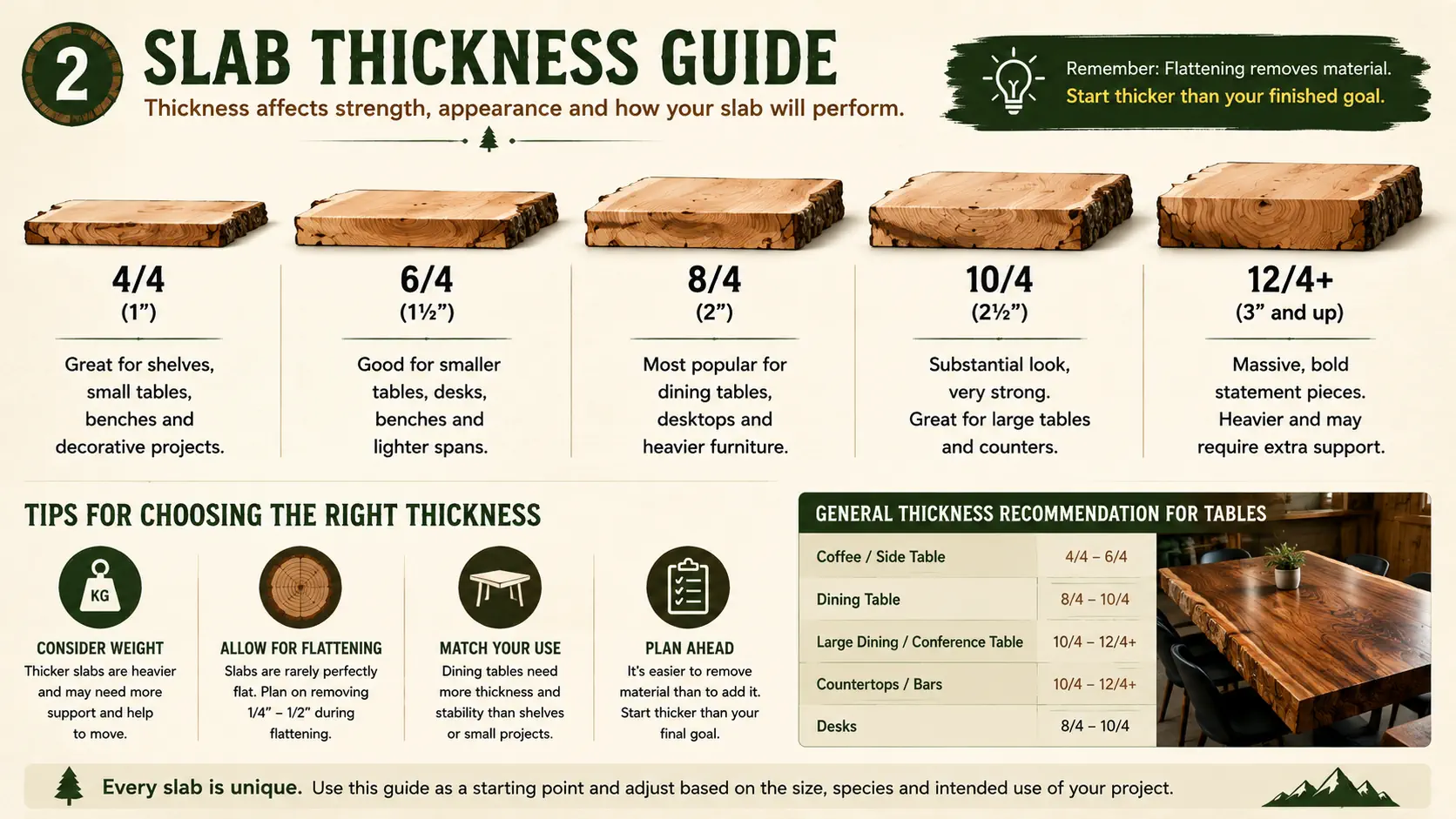
Slab thickness has both structural and visual importance.
A thick slab creates a substantial appearance, but thicker is not automatically better for every project.
The best thickness depends on:
- Project size
- Span between supports
- Type of base
- Wood species
- Desired appearance
- Expected use
- Amount of flattening required
Large dining tables and conference tables generally benefit from a more substantial slab. Desks, shelves, and smaller tables may work well with thinner material.
It is also important to understand that rough slab thickness and finished thickness are not the same.
Flattening removes material.
A rough slab may have high spots, low spots, cup, twist, or saw marks. The amount of material removed during flattening depends on the condition of the slab.
Before purchasing, consider both the current thickness and the likely finished thickness.
Understand Rough Slabs Versus Finished Slabs
Not every slab is sold at the same stage of preparation.
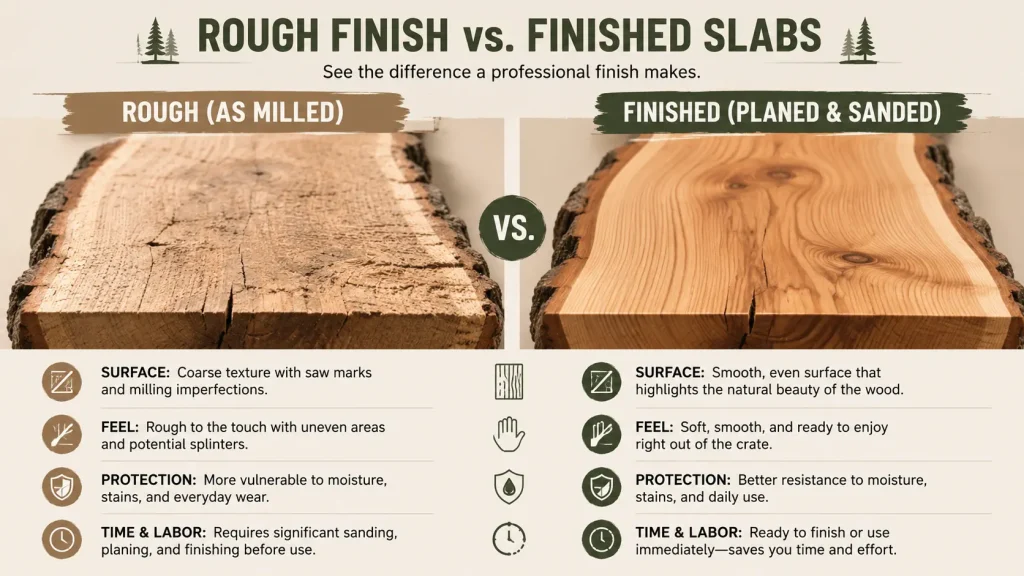
A rough slab may be:
- Freshly milled
- Air dried
- Kiln dried
- Rough sawn
- Partially flattened
- Fully flattened
- Planed
- Sanded
- Ready for finish
These differences significantly affect both the price and the amount of work required before the slab can become furniture.
A lower-priced rough slab is not necessarily less expensive by the time you include flattening, planing, sanding, transportation, and drying.
Before buying, ask exactly what preparation has been completed.
If you do not have access to large woodworking equipment, purchasing a slab that has already been properly kiln dried and can be professionally flattened may save considerable time and expense.
Why Moisture Content Matters
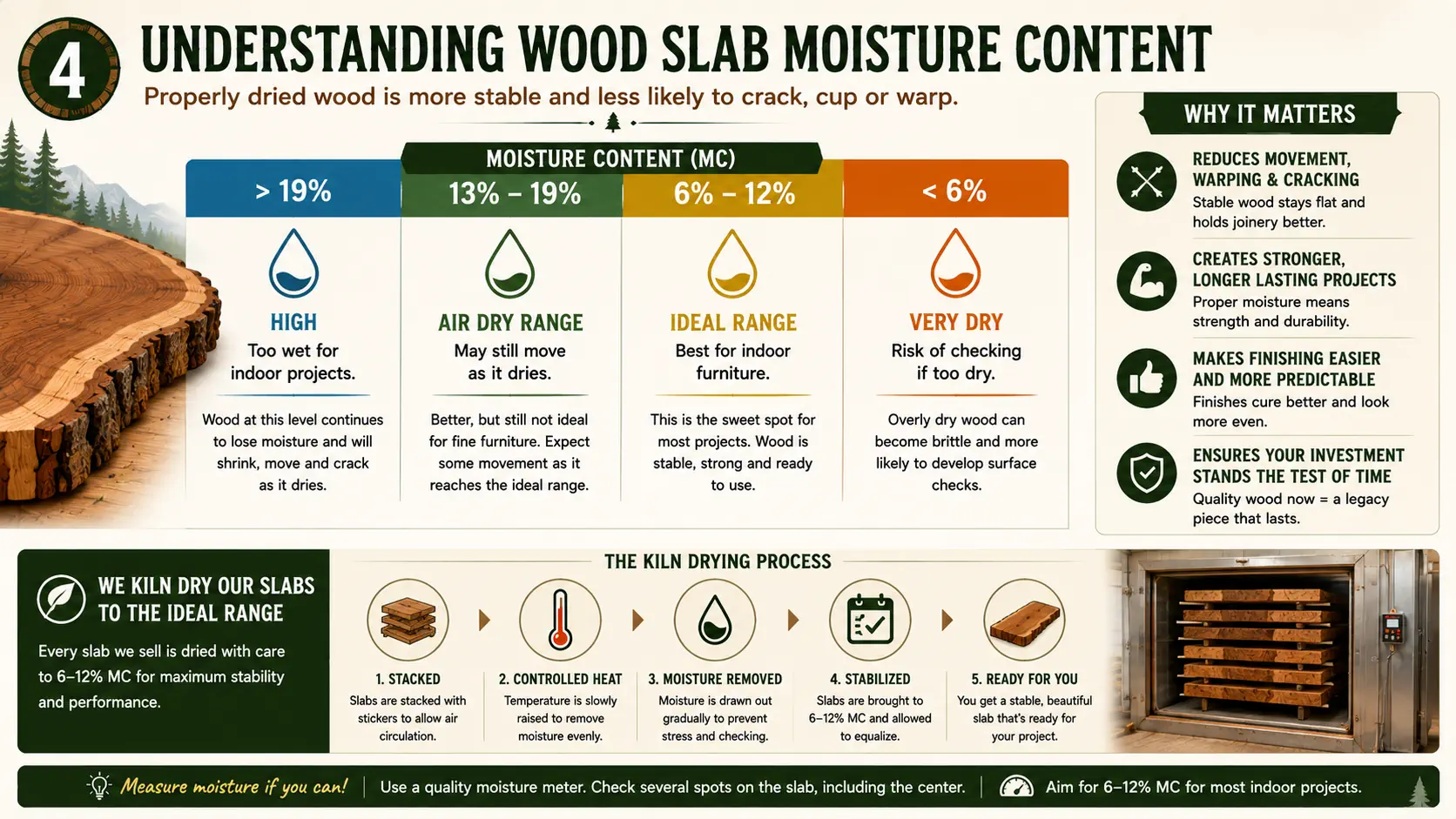
One of the most important factors when choosing a wood slab is also one of the easiest to overlook: moisture content.
Wood naturally contains moisture. As wood dries, it changes dimensions.
If a slab is used before it reaches an appropriate and stable moisture content, it may continue to shrink and move after the project is completed.
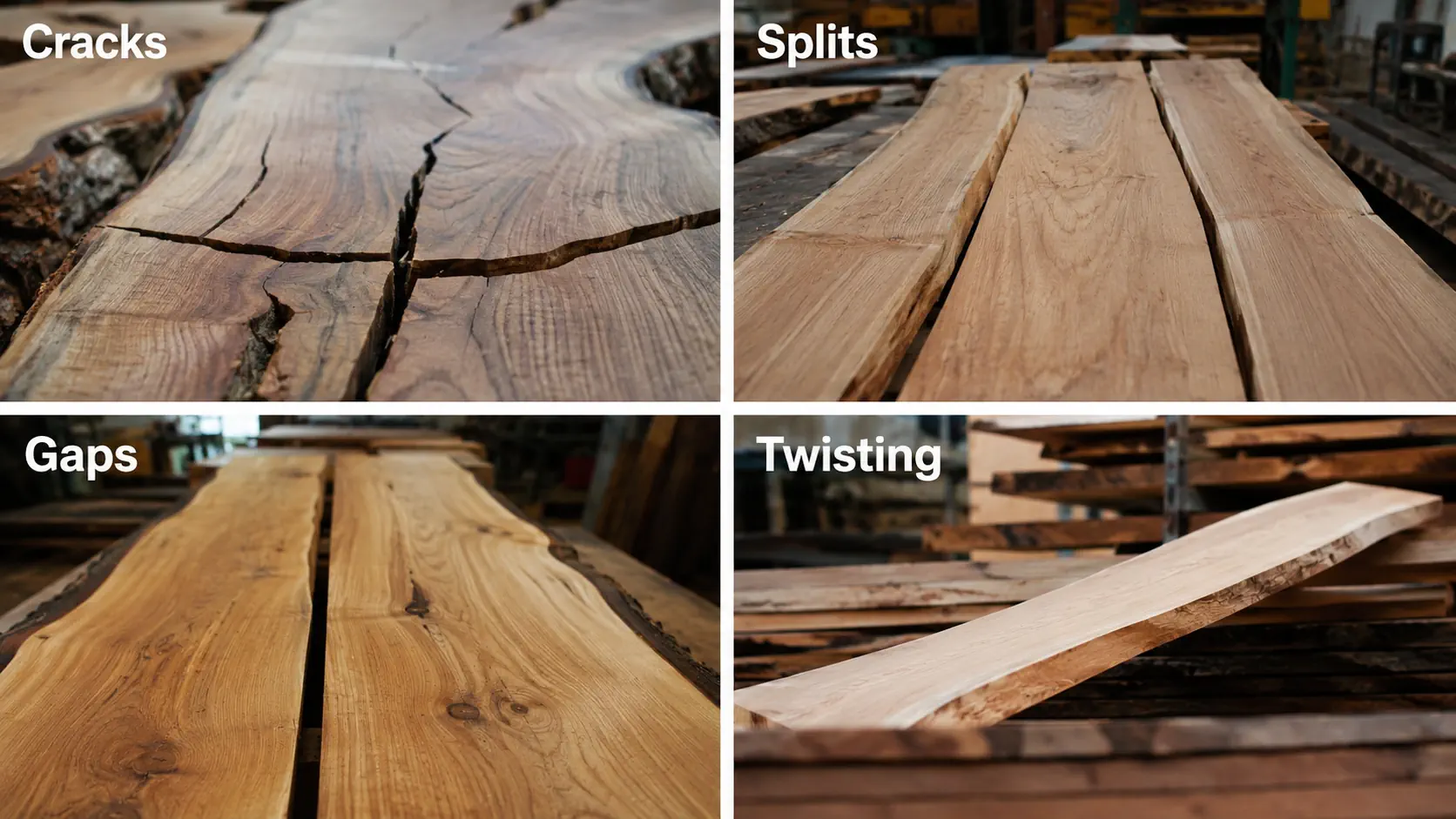
This can contribute to:
- Cracking
- Cupping
- Warping
- Twisting
- Joint failure
- Finish problems
- Changes in tabletop flatness
A slab can look dry on the outside while still holding significant moisture internally.
This is why appearance alone cannot determine whether a slab is ready for furniture making.
Moisture should be measured with an appropriate moisture meter, and the slab should be properly dried before beginning a furniture project.
For a deeper explanation of how moisture behaves inside wood, read our Complete Guide to Understanding Moisture Content in Wood.
Kiln-Dried Versus Air-Dried Slabs
Air drying and kiln drying are not the same process.
Air drying can be an important part of preparing thick lumber and slabs, but outdoor or covered air drying alone may not bring wood to an appropriate moisture level for interior furniture in many environments.
Kiln drying uses controlled conditions to continue removing moisture from the wood.
Proper kiln drying can:
- Reduce moisture content
- Improve consistency throughout the slab
- Prepare wood for interior use
- Reduce the risk of future movement
- Kill many insects and larvae that may be present in the wood
Drying thick slabs is not simply a matter of applying maximum heat. The process must be controlled to reduce the risk of excessive checking, cracking, case hardening, and other drying defects.
Before purchasing a slab, ask how it was dried and whether its moisture content has been measured.
For a detailed comparison, see our Complete Guide to Kiln-Dried vs. Air-Dried Wood.
Evaluate Grain and Figure
Grain is one of the primary reasons people choose natural wood slabs.
Unlike mass-produced materials, every solid wood slab has its own pattern.
Look at the entire slab rather than focusing on one dramatic section.
Consider how the grain will appear once the slab is:
- Cut to final length
- Flattened
- Sanded
- Finished
- Positioned in the room
Features that may add visual interest include:
- Cathedral grain
- Straight grain
- Curved grain
- Color variation
- Sapwood transitions
- Crotch figure
- Burl figure
- Mineral streaks
- Natural knots
There is no single correct grain pattern.
The best choice depends on the project and your design preferences.
A highly figured slab can become the centerpiece of a simple room, while a more consistent grain pattern may be better for minimalist furniture or a project where other design elements should receive more attention.
Understand Knots, Cracks, Checks, and Natural Character
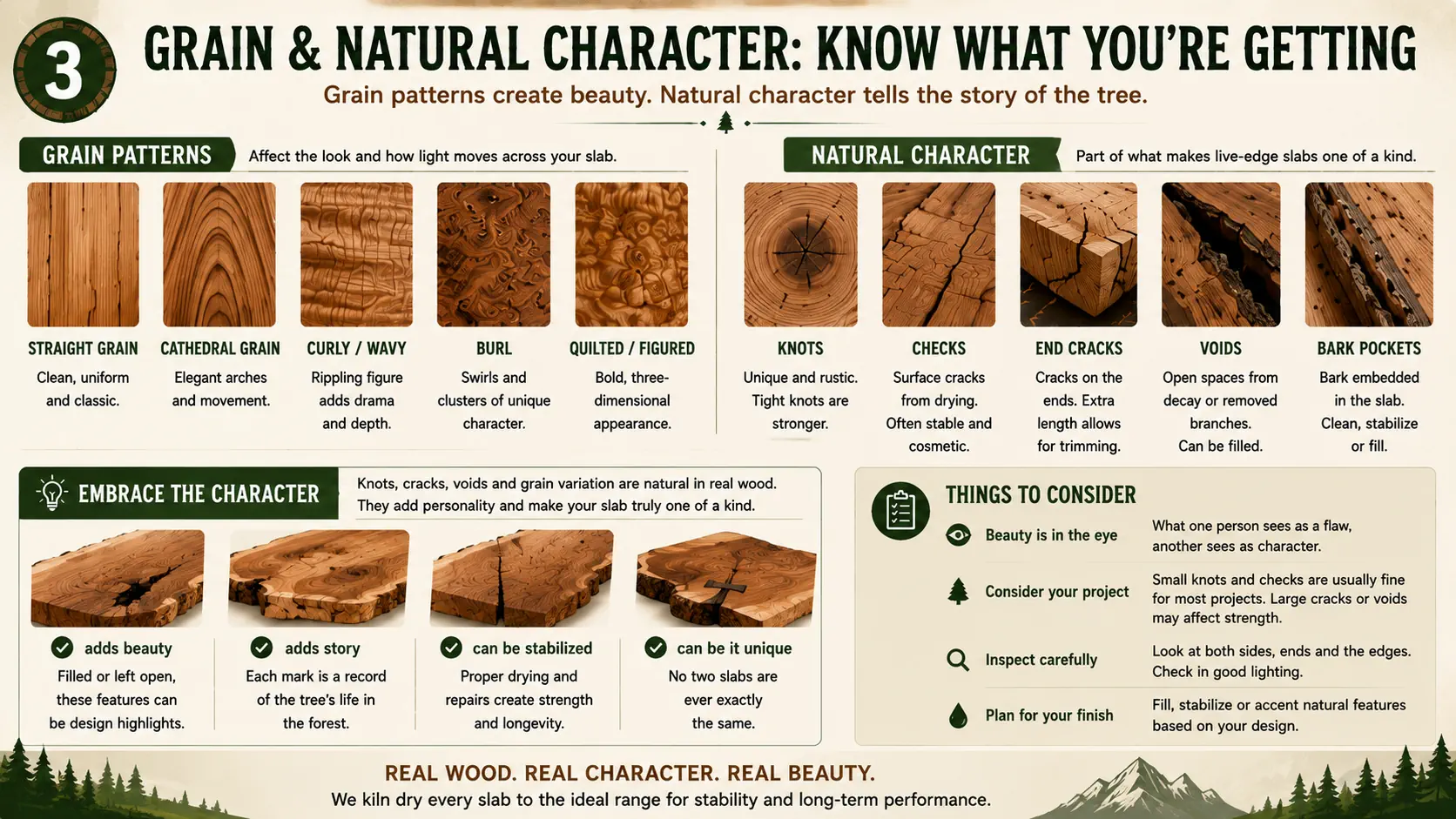
Natural features are part of the appeal of live-edge slabs, but it is important to understand what you are looking at.
Knots
Knots form where branches grew from the tree.
Some knots are tight and stable. Others may be loose, cracked, or partially missing.
Knots can become attractive features in a finished piece, especially when stabilized or filled appropriately.
Checks
Checks are separations in the wood that commonly develop during drying.
Small checks may be primarily cosmetic. Larger checks may require stabilization, trimming, bow ties, epoxy, or other repair methods depending on their location and severity.
End Cracks
Cracking often begins at the ends of logs and slabs because moisture can leave the end grain more rapidly.
Some end cracking can simply be trimmed away if the slab has sufficient extra length.
This is another reason to purchase a slab longer than the exact finished dimension.
Voids
Natural voids can become major design elements.
Some builders preserve them. Others fill them with clear, tinted, or colored epoxy.
The important question is whether the feature is structurally manageable and compatible with your intended design.
Natural character is not automatically a defect. In live-edge woodworking, many features that would be rejected in conventional lumber are precisely what make a finished piece unique.
Check for Cupping, Bowing, and Twisting
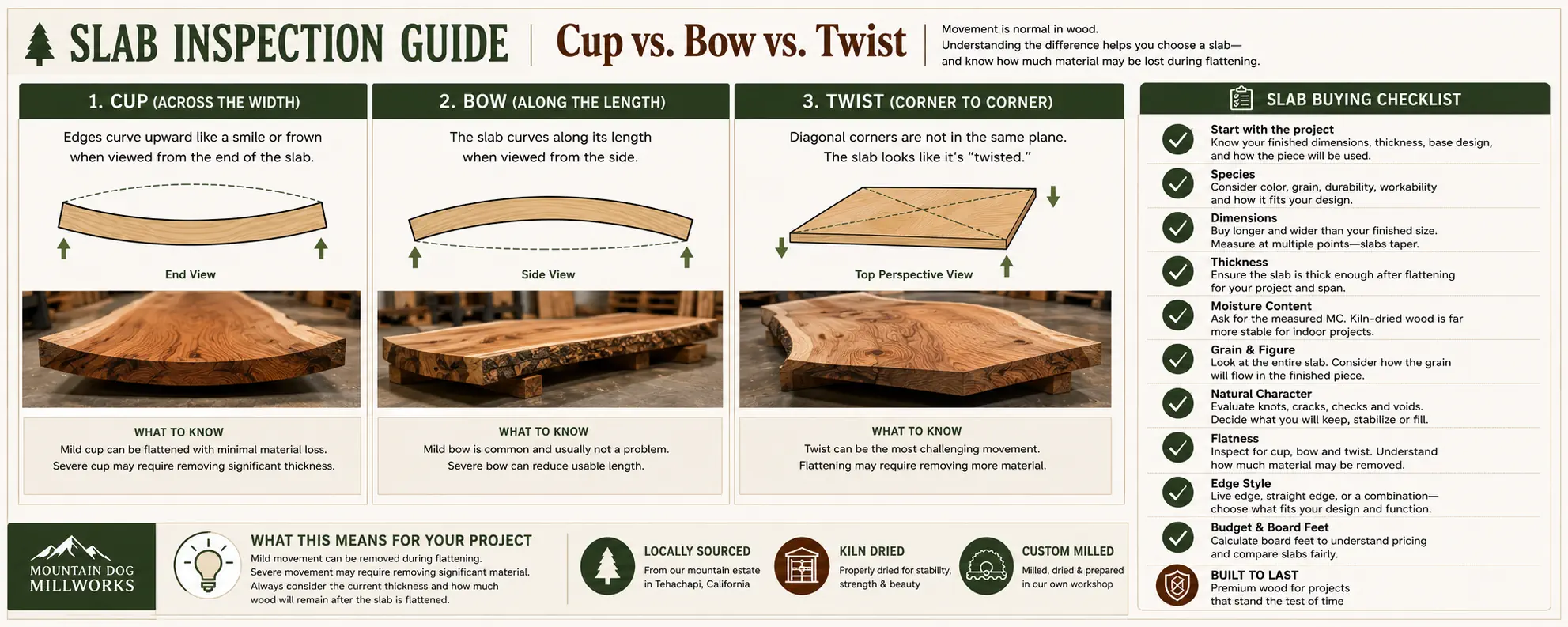
Wood movement can affect the amount of usable material in a slab.
Before purchasing, inspect the slab for:
Cupping
Cupping occurs when the slab curves across its width.
A mildly cupped thick slab may be flattened successfully, but significant cupping can require the removal of substantial material.
Bowing
Bowing is curvature along the length of the slab.
The effect of a bow depends on the slab length, thickness, and planned project.
Twisting
Twist occurs when different corners of the slab are not in the same plane.
Twist can be more challenging because flattening may require removing significant thickness from opposite areas of the slab.
None of these conditions automatically make a slab unusable.
The key question is how much material will remain after the slab is flattened.
A thick slab with moderate movement may still produce an excellent finished piece. A thin slab with severe twist may not.
Live Edge or Straight Edge?
One of the major design decisions is whether to preserve the natural edge of the slab.
Live Edge
A live edge follows the natural outer shape of the tree.
Live-edge slabs work especially well for:
- Dining tables
- Coffee tables
- Desks
- Benches
- Bar tops
- Mantels
- Shelves
- Console tables
The edge can be cleaned and preserved while retaining the natural contour.
Straight Edge
A straight edge creates a more refined and geometric appearance.
Straight-edged slabs may be preferable for:
- Countertops
- Built-ins
- Modern desks
- Tables placed against walls
- Projects requiring precise joinery
A slab does not have to be entirely live edge or entirely straight edge. Many projects use one natural edge and one straight edge.
Choose the edge treatment based on how the finished piece will function in the room.
Sapwood Versus Heartwood
Many slabs contain both heartwood and sapwood.
Heartwood is the older inner portion of the tree. Sapwood is the younger outer wood that transported water and nutrients while the tree was growing.
The color difference between heartwood and sapwood varies by species.
Some woodworkers prefer a consistent color, while others intentionally choose slabs with dramatic transitions.
Neither choice is universally better.
When choosing a slab, think about whether you want:
- Consistent color
- High contrast
- Dramatic natural transitions
- Rustic variation
- A more uniform furniture appearance
Remember that finish can deepen and change the appearance of both heartwood and sapwood.
Whenever possible, evaluate a sample area with the type of finish you plan to use.
Single Slab or Multiple Slabs?
Not every project needs to be made from one extremely wide slab.
Multiple slabs can be joined to create a wider surface.
This approach can be practical for:
- Dining tables
- Conference tables
- Countertops
- Desks
- Large work surfaces
Slabs can be selected for compatible grain, color, thickness, and edge shape.
Bookmatched slabs are created from sequential cuts and opened like the pages of a book. This can produce a dramatic mirrored appearance.
When choosing multiple slabs, consider how the grain patterns will interact after joining.
The goal is not always perfect symmetry. In some projects, complementary natural variation creates a more interesting result.
Consider the Base Before Buying the Slab
The tabletop and base should be planned together.
A large, heavy slab needs adequate support.
Before buying the slab, consider:
- Base width
- Leg placement
- Table overhang
- Seating clearance
- Slab weight
- Span between supports
- Attachment method
- Allowance for seasonal wood movement
A beautiful slab can become uncomfortable or unstable if paired with the wrong base.
For dining tables, leg placement should allow adequate seating space. For desks, the base should provide legroom. For long slabs, support should be designed to minimize sagging and instability.
Solid wood also moves across the grain as humidity changes.
Attachment methods should allow appropriate seasonal movement rather than rigidly restricting the slab.
Calculate Board Feet Before Buying
Many wood slabs are priced by the board foot.
A board foot is a volume measurement equal to a piece of wood:
12 inches wide × 12 inches long × 1 inch thick.
The basic formula is:
Thickness in inches × Width in inches × Length in inches ÷ 144
Mountain Dog Millkworks Board Foot Calculator
For irregular live-edge slabs, width may be calculated using an average measurement.
Understanding board feet helps you:
- Compare slabs
- Estimate material cost
- Plan your budget
- Understand species price differences
- Compare different slab sizes
Use our Board Foot Calculator to quickly estimate the board footage of your slab.
Allow for Flattening and Final Preparation
A rough slab is not the same size as the finished piece.
Depending on its condition, preparation may include:
- Flattening
- Planing
- Trimming
- Jointing
- Bark removal
- Edge cleanup
- Crack stabilization
- Epoxy filling
- Progressive sanding
- Final surface preparation
Each process can change the slab dimensions.
This is particularly important with thickness.
If your design requires a specific finished thickness, make sure the rough slab has enough material to allow for flattening.
Ask about available flattening and sanding services before buying if you do not have the equipment required to process large slabs.
Think About Transportation Before You Buy
Large slabs are heavy and awkward to move.
Oak in particular can become extremely heavy at furniture-scale dimensions.
Before purchasing, consider:
- Vehicle size
- Slab length
- Slab weight
- Number of people needed to move it
- Doorway dimensions
- Stairways
- Hallways
- Final installation location
For large tables and counters, plan the entire route from the workshop or delivery vehicle to the final room.
A finished table may be significantly more difficult to move than the unfinished slab.
In some cases, removable bases or final assembly at the installation location can make transportation easier.
Store and Acclimate the Slab Properly
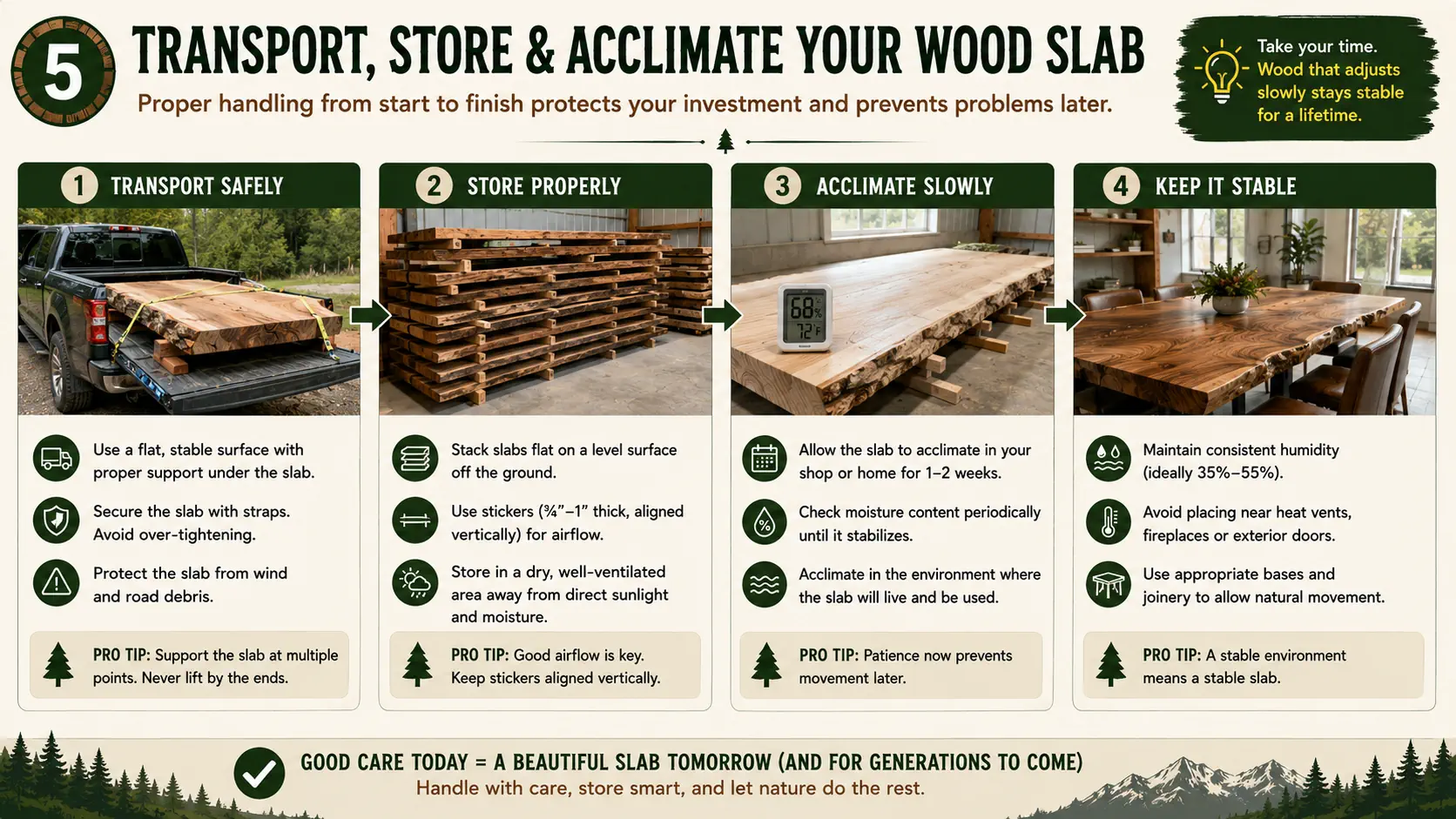
After bringing a slab into your workshop, store it properly before beginning the project.
Do not place a slab directly on a concrete floor.
Support it evenly and allow air circulation.
Depending on the slab, workshop conditions, and final destination, an acclimation period may be appropriate before final construction.
The goal is to allow the wood to adjust gradually to its working environment while maintaining proper support.
Avoid sudden and extreme environmental changes whenever possible.
A properly dried slab can still respond to significant changes in humidity. Wood remains a natural, hygroscopic material even after kiln drying.
Choose the Finish With the Project in Mind
The final finish should be considered when selecting the slab.
Different finishes can dramatically change the appearance of wood.
A finish may:
- Darken the wood
- Increase grain contrast
- Warm the color
- Highlight figure
- Reduce the appearance of pale areas
- Increase contrast between heartwood and sapwood
The best finish also depends on how the project will be used.
A decorative shelf does not require the same surface protection as a dining table or kitchen counter.
Before finishing the entire project, test the finish on an offcut or inconspicuous area whenever possible.
For detailed species-specific finishing information, see our Complete Guide to Finishing and Protecting Pine, Redwood, Douglas Fir, and Oak.
Questions to Ask Before Buying a Wood Slab
Before purchasing a slab, ask:
- What species is the slab?
- What are the minimum and maximum dimensions?
- What is the current thickness?
- Is the slab rough sawn or flattened?
- Has the slab been kiln dried?
- What is its current moisture content?
- How was the moisture content measured?
- Does the slab have significant cup, bow, or twist?
- Are the cracks stable?
- Are there loose knots or structural voids?
- How much material may be lost during flattening?
- Are flattening and sanding services available?
- Can the slab be cut to a specific length?
- Is delivery available?
- What finish is recommended for the intended use?
A reputable millworks or slab supplier should be willing to discuss these questions.
Common Mistakes When Choosing a Wood Slab
The most common slab-buying mistakes are usually avoidable.
Buying Based Only on Appearance
A beautiful slab may not be suitable for the intended project.
Always consider moisture content, dimensions, thickness, movement, and structural condition.
Buying the Exact Finished Size
Allow extra material for trimming and preparation.
Ignoring Moisture Content
A slab that looks dry may not be ready for furniture making.
Underestimating Flattening
A slab with cup or twist may lose significant thickness during flattening.
Forgetting About the Base
The slab and support system should be designed together.
Ignoring Transportation
Measure doors, stairs, hallways, and installation spaces before building a large piece.
Choosing Price Over Preparation
A cheap wet or poorly prepared slab can become expensive after drying, flattening, and correcting problems are considered.
The Best Slab Is the One That Fits Your Project
There is no single perfect wood species or slab for every project.
The best slab is the one that provides the right combination of:
- Size
- Thickness
- Species
- Grain
- Natural character
- Moisture content
- Stability
- Workability
- Durability
- Budget
A dramatic Redwood slab may be ideal for a statement table. Oak may be the better choice for a heavily used dining surface. Pine may provide the perfect combination of character, workability, and value for a DIY project. Douglas Fir may complement a mountain, craftsman, rustic, or contemporary interior.
The key is to select the slab based on both appearance and function.
From Our Forest to Your Home
At Mountain Dog Millworks, our wood begins with locally and responsibly harvested timber from our mountain estate in Tehachapi, California.
We mill and kiln dry our timber in our own workshop, allowing us to follow the process from tree to finished slab.
Our available wood includes Pine, Redwood, Douglas Fir, and Oak, with individual slabs offering their own unique grain, color, edge shape, knots, and natural character.
We also offer custom milling and slab preparation services for customers who want help turning natural timber into a finished project.
Whether you are building a dining table, desk, countertop, mantel, bench, shelf, or something completely original, choosing the right slab is where the project begins.
Explore our available kiln-dried wood slabs, learn more about our custom milling services, or contact Mountain Dog Millworks to discuss the right material for your next woodworking project.