
What Is Kiln Drying and Why It Matters for Your Wood
At Mountain Dog Millworks, we take pride in providing high-quality kiln dried slabs that are stable, beautiful, and ready for your woodworking projects. Kiln drying is the controlled process of removing moisture from wood, and it’s critical for preventing warping, cracking, checking, and mold growth later on. This post walks you through our proven kiln drying process and highlights what we carefully monitor at each step to ensure top results.
Step 1: Starting With the Right Timber
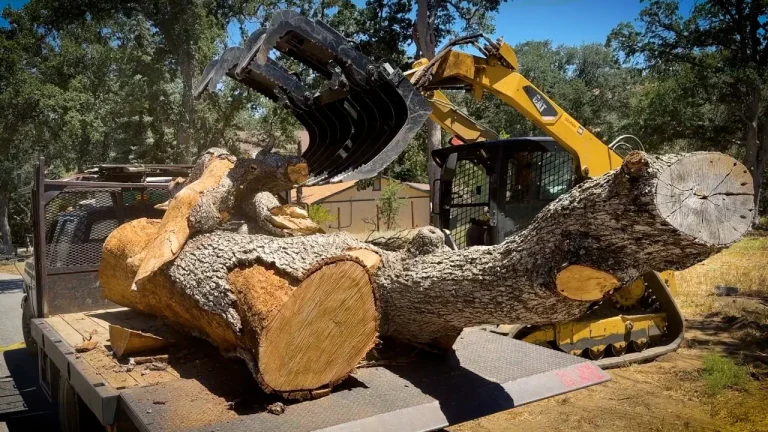
Every successful kiln drying cycle begins with selecting the right wood. We only work with responsibly and sustainably harvested timber—pine, fir, red oak, and redwood—and each log is inspected before cutting.
Why this matters:
Wood with visible defects (excessive knots, signs of decay, or inconsistent grain) can dry unevenly, increasing the risk of cracking or internal stress.
What we check:
- Grain orientation
- Consistent thickness and width
- Absence of rot or insect damage
Step 2: Initial Moisture Content Measurement
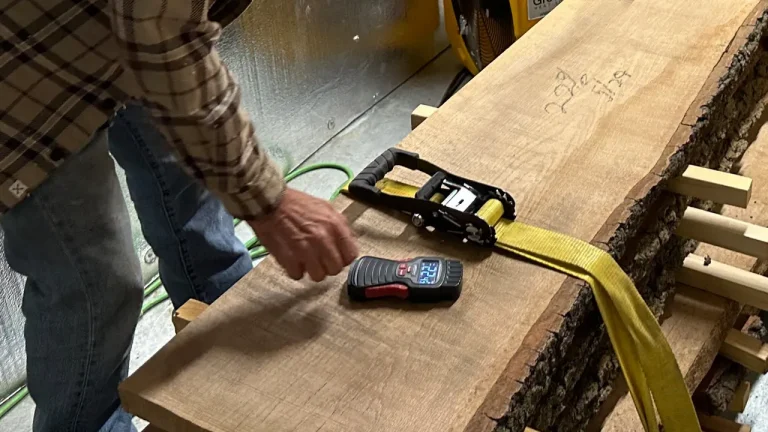
Before the wood ever enters our kiln, we use precise moisture meters to measure the initial moisture content (MC) of each slab.
Why this matters:
Kiln drying is all about reducing moisture content—from green (fresh cut) levels down to a stable percentage that suits indoor environments (typically 6–8% for most slab projects).
What we check:
- MC readings across multiple points on the board
- Consistency within the same slab
If different areas of the slab have dramatically different moisture readings, we adjust our drying strategy accordingly.
Step 3: Loading Into the Kiln
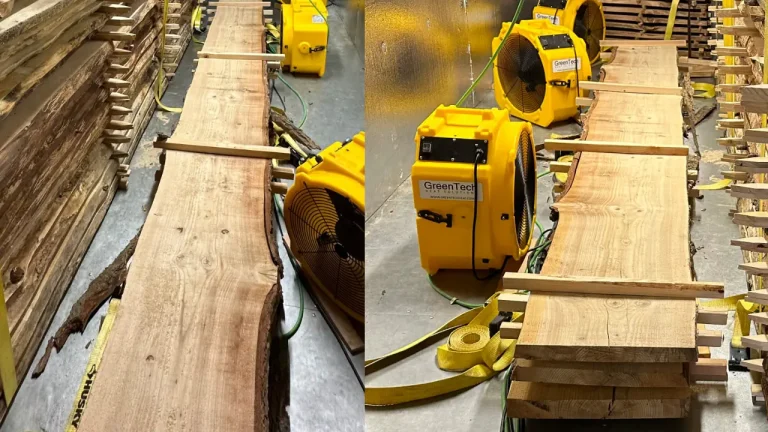
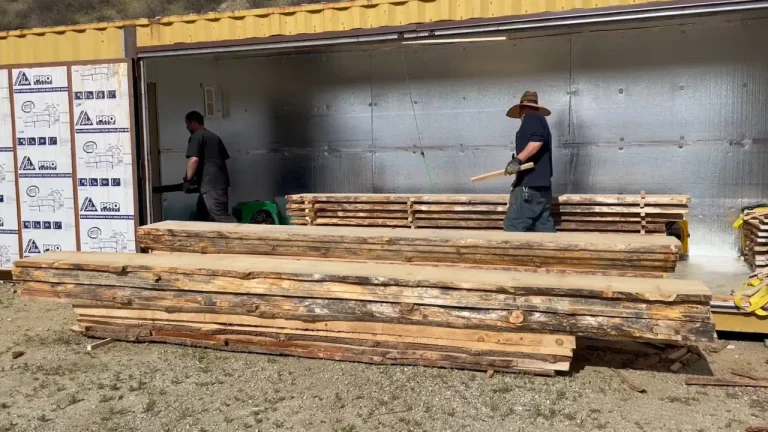
Once measured, slabs are stacked in our kiln with spacers (called stickers) between them to allow even airflow.
Why this matters:
Proper stacking prevents moisture gradients and encourages uniform drying, reducing stress that can cause warping.
What we check:
- Even spacing between boards
- Correct airflow paths
- Orientation of slabs based on species and size
Step 4: Controlled Drying Cycle
Inside the kiln, we carefully control both temperature and humidity to optimize drying. The key here is not to dry too quickly.
Drying Stages:
- Free-water evaporation – initial phase where liquid water evaporates from cell cavities
- Bound water removal – more challenging phase where moisture in cell walls leaves the wood
Why this matters:
Removing moisture too fast can lead to stress cracks and checking. We avoid this by ramping temperatures and controlling humidity in stages.
What we monitor regularly:
- Kiln temperature set points
- Relative humidity levels
- Rate of moisture loss per slab
Step 5: Regular Moisture Monitoring
Throughout the drying cycle, we routinely pull slabs for spot-checking moisture levels.
Why this matters:
Continuous monitoring tells us whether the wood is drying uniformly and whether adjustments are needed to maintain quality and prevent defects.
What we check:
- Surface and core moisture readings
- Humidity fluctuations
- Evidence of surface checking or cupping
Step 6: Cooling and Conditioning
Once slabs reach the target moisture content, we don’t rush to remove them. They go through a conditioning phase, where temperature and moisture stabilize.
Why this matters:
Rapid cooling can reintroduce stresses. Conditioning helps relax internal stresses and keeps slabs flat and true.
What we check:
- Stable MC across board thickness
- No evidence of tension or compression stress
Step 7: Final Inspection Before Shipping
Before any slab leaves our workshop, each piece receives a final quality check.
Why this matters:
Your project deserves lumber that’s already done the hard work—no surprises after purchase.
What we verify:
- Final moisture readings
- Flatness and straightness
- Surface condition
- Ready-to-work quality
How Our Kiln Dried Slabs Benefit Your Project
By carefully controlling every stage of the drying process and checking multiple quality factors:
✅ You get wood that is stable and predictable
✅ Projects are less prone to movement or defects
✅ Finishes adhere better and behave more consistently
✅ Milling or joinery goes smoothly